

 English
 Deutsch
 Italiano
 Français
 Español
 Português
 Polski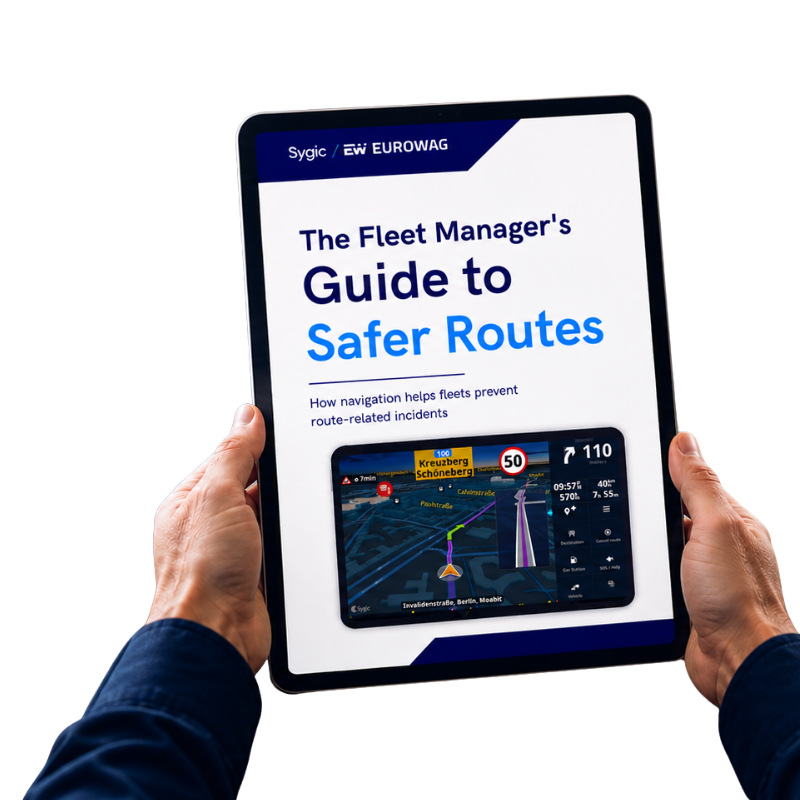

Truck Specific Routing
Truck-specific routing avoids low bridges, weight limits, restricted zones, and unsuitable roads. Routes use vehicle height, weight, length, axle load, and cargo type. This helps prevent collisions, violations, and delays.
Hazard and Road-Condition Alerts
Hazard Alerts warn drivers about sharp curves, steep gradients, railway crossings, restricted sections, and upcoming speed-limit changes. Drivers get enough time to slow down and stay safe.
Safer Turns
The routing engine uses turn logic that reduces exposure to risky intersections. In left-hand-drive markets it prefers right turns. In the UK and Australia it reverses. This lowers conflict points and supports safer urban driving.
Safe Arrivals for Delivery
Drivers approach delivery points from the correct side of the road. This reduces unsafe turning, limits crossing through traffic, and simplifies final approach.
Speed-Limit Warnings
Clear visual speed limits and upcoming changes give drivers enough time to adjust their speed safely.
Lane Guidance
Dynamic lane guidance helps drivers navigate complex junctions and motorways without last second lane changes.
Voice Instructions
Clear voice instructions in 40+ languages support hands-free operation and help drivers stay focused on the road.
Reliable Routing
Reliable Routing ensures drivers stay on the correct path in every situation. The navigation can calculate routes on the device, and it can also follow a pre-computed route created in the backend, so dispatch can control the exact path the vehicle takes. Offline maps keep the route active in low-signal areas, tunnels, mountains, and rural zones, which removes the uncertainty of connectivity drops and prevents unwanted detours.
Let's Talk
Need a quote?
Want to try out the solution?
Need expert guidance?
Fill out this form, and we'll get back to you as soon as we can.
Not here for business?
Hop into our Support Center.